Buying New and Used Mowers
How to Store a Lawn Mower for Winter (and When You Shouldn't)
The timing depends on your region and how often the mower is used. In Florida, coastal areas, and other markets with year-round mowing, full winterization may not be necessary. A mower that remains in active use should follow its normal maintenance schedule instead of sitting idle for months.
How to Store a Lawn Mower for Winter (and When You Shouldn't)
For most gas-powered mowers in cold-weather regions, winter storage requires six core steps:
- Stabilize or drain the fuel.
- Change the oil if required.
- Clean and dry the mower deck.
- Disconnect, remove, or maintain the battery.
- Check tires, belts, grease points, and moving parts.
- Store the mower in a dry, level, covered location.
The timing depends on your region and how often the mower is used. In Florida, coastal areas, and other markets with year-round mowing, full winterization may not be necessary. A mower that remains in active use should follow its normal maintenance schedule instead of sitting idle for months.
When Winterizing Is the Wrong Move
Winterization makes sense when a mower will remain unused through freezing weather or a long off-season. It is less useful when the machine will continue working.
Avoid full winter storage preparation when:
- The mower is still used regularly.
- Grass continues growing through winter.
- The local climate has mild temperatures and limited frost.
- The mower is part of an active lawn care operation.
- The equipment will be used again within a short period.
In warm-weather markets, repeatedly draining fuel and leaving a mower unused can create its own problems. Fuel may be handled unnecessarily, batteries can lose charge, tires can develop flat spots, and moisture can affect exposed metal and moving parts during long idle periods.
For year-round mowing regions, keep the mower clean and dry, follow the manufacturer’s maintenance schedule, inspect the fuel regularly, and operate the equipment often enough to avoid extended inactivity.
Six Core Steps for Winter Lawn Mower Storage
1. Handle the Fuel
Old fuel is often one of the main reasons a mower will not start in spring. Gasoline can degrade during storage, and ethanol-blended fuel may attract moisture or contribute to corrosion and deposits in the fuel system.
There are two common storage approaches.
Use Fresh Fuel and Stabilizer
This option works for many mowers stored in a garage or shed.
- Add fresh fuel to the tank.
- Add fuel stabilizer according to the product label.
- Run the mower for several minutes in a properly ventilated area.
- Allow treated fuel to move through the fuel system.
- Follow the owner’s manual if it specifies a different process.
Do not guess at the stabilizer ratio. Product directions vary, and the correct amount depends on the stabilizer and fuel quantity.
A full tank may reduce the amount of air space where condensation can form, but only use this approach when the storage location is appropriate and the owner’s manual permits it.
Drain the Fuel
Draining may be preferable when the mower will be stored for an extended period, when the fuel is already old, or when the mower must be stored in a location where gasoline fumes are not appropriate.
Use an approved fuel container and follow the mower manufacturer’s instructions. If the model allows it, the engine may be run until the carburetor and fuel line are empty. Do not pour gasoline onto the ground or leave fuel in an unapproved container.
Fuel should never be stored in a living area. Keep gasoline away from heat sources and ignition sources.
2. Change the Oil and Check the Filters
For gas-powered four-cycle engines, changing the oil before storage can remove contaminants and moisture that would otherwise remain in the engine during the off-season.
Check the owner’s manual for:
- Recommended oil type.
- Oil capacity.
- Change intervals.
- Filter replacement requirements.
- Whether the engine uses a replaceable oil filter.
Warm the engine briefly if the manual recommends it, then drain the old oil safely and refill it to the correct level. Do not overfill.
Inspect the air filter. Clean or replace it if required. Replace a fuel filter or spark plug only when the maintenance schedule, condition, or owner’s manual calls for it.
Battery-powered mowers do not need engine oil, but their batteries still require storage preparation.
3. Clean the Deck and Chassis
Grass buildup holds moisture against the deck. During winter storage, that moisture can contribute to rust, corrosion, and deterioration of painted surfaces.
Before cleaning:
- Shut off the mower.
- Remove the key if equipped.
- Disconnect the spark plug wire on gas models.
- Remove the battery on electric models.
- Follow the owner’s manual before working near blades.
Remove packed grass from the underside of the deck with a suitable scraper or brush. Clean the wheels, cooling areas, discharge chute, and accessible parts of the chassis.
If water is used, dry the mower completely before covering it. Do not leave moisture trapped beneath a cover.
A clean deck also makes spring inspection easier. Cracks, bent metal, worn blades, damaged pulleys, and loose hardware are easier to identify when grass and dirt are removed.
4. Disconnect and Maintain the Battery
Cold temperatures and long periods of inactivity can reduce battery performance. Battery terminals can also corrode when exposed to moisture and dirt.
For a removable battery or traditional riding mower battery:
- Turn the mower off.
- Disconnect the negative cable first when applicable.
- Disconnect the positive cable.
- Remove the battery if the manual recommends it.
- Clean the terminals.
- Store the battery in a cool, dry location.
- Keep it away from fuel, heat sources, and loose metal objects.
A battery maintainer or trickle charger can help maintain a traditional battery during storage. Use a charger designed for the battery type and follow its instructions.
Lithium-ion mower batteries require different storage and charging procedures. Check the battery and mower manuals rather than applying lead-acid battery advice to a lithium battery.
5. Check Tires, Belts, and Moving Parts
Inspect the mower before parking it for the season. Look for:
- Low or damaged tires.
- Loose or worn belts.
- Bent pulleys.
- Damaged deck wheels.
- Loose hardware.
- Dry grease points.
- Stiff linkages.
- Leaks around the engine or transmission.
Inflate tires according to the owner’s manual. Tires that remain under load in one position for several months can develop flat spots. Moving the mower occasionally may help, but a proper spring inspection is still necessary.
Grease fittings and pivot points should be serviced according to the maintenance schedule. Do not apply lubricant to belts or areas where it could reach a pulley or brake surface.
6. Choose the Right Storage Location
The best lawn mower storage area is:
- Dry.
- Covered.
- Level.
- Protected from direct weather.
- Free of standing water.
- Away from furnaces, stoves, and water heaters.
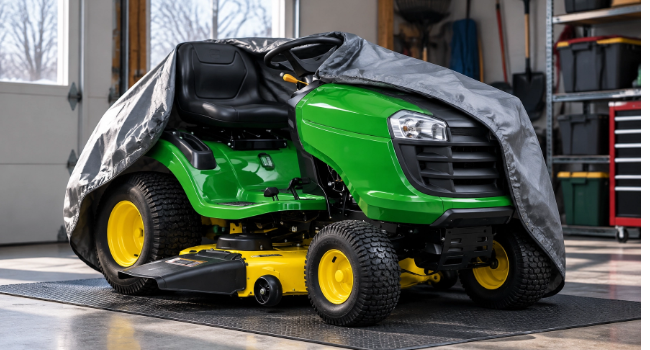
A garage or shed is usually better than an outdoor tarp. If the mower must remain outside, use a cover designed for outdoor equipment and keep the mower elevated from standing water.
Avoid bare concrete when possible. A rubber mat, wood platform, or other dry barrier can reduce direct contact with damp concrete. The surface should remain stable and level.
Use a breathable cover rather than wrapping the mower tightly in plastic. Trapped condensation can damage metal components and upholstery.
Spring Restart Checklist
Before starting the mower after storage:
- Remove the cover and inspect the mower for moisture, corrosion, nesting material, or chewed wiring.
- Check the tires and look for leaks.
- Reinstall the battery if it was removed.
- Inspect and clean the battery terminals.
- Check the oil level.
- Add fresh fuel if the tank was drained.
- Inspect the fuel lines for cracks or leaks.
- Reconnect the spark plug wire.
- Check the deck, blades, belts, and pulleys.
- Start the mower according to the owner’s manual.
- Let it run briefly and listen for unusual sounds.
- Test the controls before mowing.
Do not operate the mower if fuel is leaking, wiring is damaged, safety controls are not working, or a belt or blade appears loose.
Store a Mower You Plan to Sell
Winter storage affects more than spring starting. It can also affect the mower’s possible resale value and a buyer’s first impression.
Sellers and mower flippers should document:
- Storage date.
- Fuel treatment or draining method.
- Oil change date.
- Battery removal or maintenance.
- Deck cleaning.
- Blade, belt, and tire condition.
- Current hour-meter reading.
- Repairs completed before storage.
- Photos showing clean, dry storage.
Storage does not reduce the hours shown on the meter. It also does not replace mechanical inspection. Buyers may still want to see the mower start, operate, and perform basic functions.
A clean mower with organized maintenance records gives buyers more useful information than a machine that has simply been covered and left untouched. Avoid hiding worn parts beneath a cover. Correct known issues before listing when the repair makes financial sense.
Use [INTERNAL LINK: our lawn mower listing mistakes guide] when preparing photos, descriptions, and condition notes. For commercial equipment, include clear information about operating hours and maintenance history. [INTERNAL LINK: our zero-turn hours guide] can help frame hour-meter information accurately without treating hours as the only measure of condition.
If storage is not practical, review used riding lawn mowers and compare equipment that may fit the next mowing season. Buyers looking for larger commercial machines can also browse used zero turn mowers for sale.
Browse and List Mowers
Store equipment according to its climate, fuel system, battery type, and expected downtime. Northern owners may need full winterization. Southern owners and active lawn care businesses may need routine maintenance instead of long-term storage.
When it is time to replace equipment, browse all mower listings on LawnMowerClassifieds.com. Private sellers can also list a mower for sale free.
SEO Package
- Category: Ownership and Maintenance
- Primary Keyword: how to store a lawn mower for winter
- Secondary Keywords: winter lawn mower storage, mower winterization, lawn mower storage, used riding lawn mowers, used zero turn mowers for sale
- Search Intent: Informational and how-to
- Target Audience: Homeowners, mower owners, lawn care professionals in northern markets, mower sellers, and mower flippers
- Excerpt: Learn how to store a lawn mower for winter, including fuel, oil, deck cleaning, battery care, tire checks, and spring restart steps. See when full winterization is unnecessary in warm-weather regions.
- SEO Title: How to Store a Lawn Mower for Winter
- Meta Description: Learn how to store a lawn mower for winter with practical steps for fuel, oil, cleaning, batteries, tires, storage, and spring restart.
- Featured Image Idea: A clean riding mower under a breathable cover in a dry garage with a rubber mat beneath the tires.
- Featured Image Alt Text: Riding lawn mower stored under a breathable cover in a dry garage
- Internal Links: Embedded naturally throughout the article
- CTA: Browse mower listings or list a mower free on LawnMowerClassifieds.com